

Hi friend,
Thanks for reading and supporting this newsletter! If you enjoy today’s post… please share.
Did you know that if you hit the heart at the top or the bottom of this email you will make my day and it will make it easier for others to find this publication. Thanks!
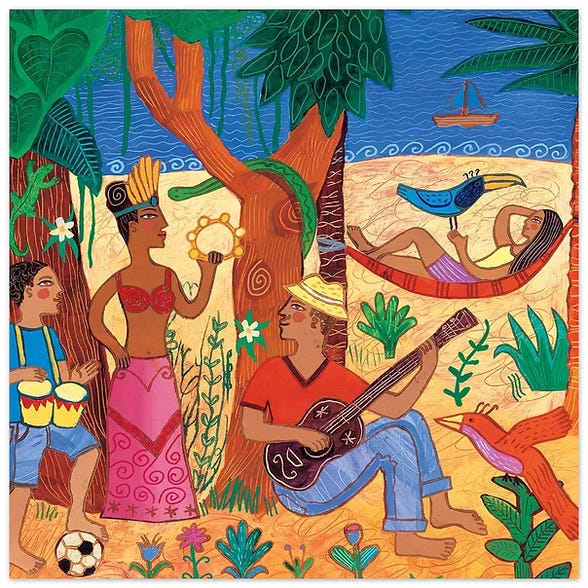
Several years ago I worked for the independent record label Putumayo World Music. Putumayo specialized in putting together CD compilations of music from around the world. The idea was, if someone was interested in exploring music from Brazil, Mali, Cuba, the Middle East, these packages, with their vibrant folk-art covers and extended CD booklets with information about the regions and artists, were accessible. You didn’t have to go into a record store and flip through countless CDs in the world music section and guess on something to buy. Putumayo took care of curating the music, and the cultural experience, for you in one neat little package of music and art.
Putumayo considered itself more of a ‘lifestyle’ brand than a traditional record label. And even though you could find Putumayo CDs in the bins of traditional record stores, the main focus was selling in ‘non-traditional’ stores such as gift shops, bookstores, museum shops and even Whole Foods. Putumayo would supply the stores with hand-crafted counter displays and listening stations and, key to sales, CDs to play in the store. The idea was, you walk into a craft store, hear the music overhead that fit the vibe of the store, see the colorful CDs displayed on a counter near the register, and… impulse sale! Market research showed that once a customer purchased a Putumayo CD, they generally purchased many more, as gifts, and for themselves.
The music was great, the package was informative and appealing, and it offered up an ‘experience’. Putumayo’s tag line - “Guaranteed to make you feel good.”
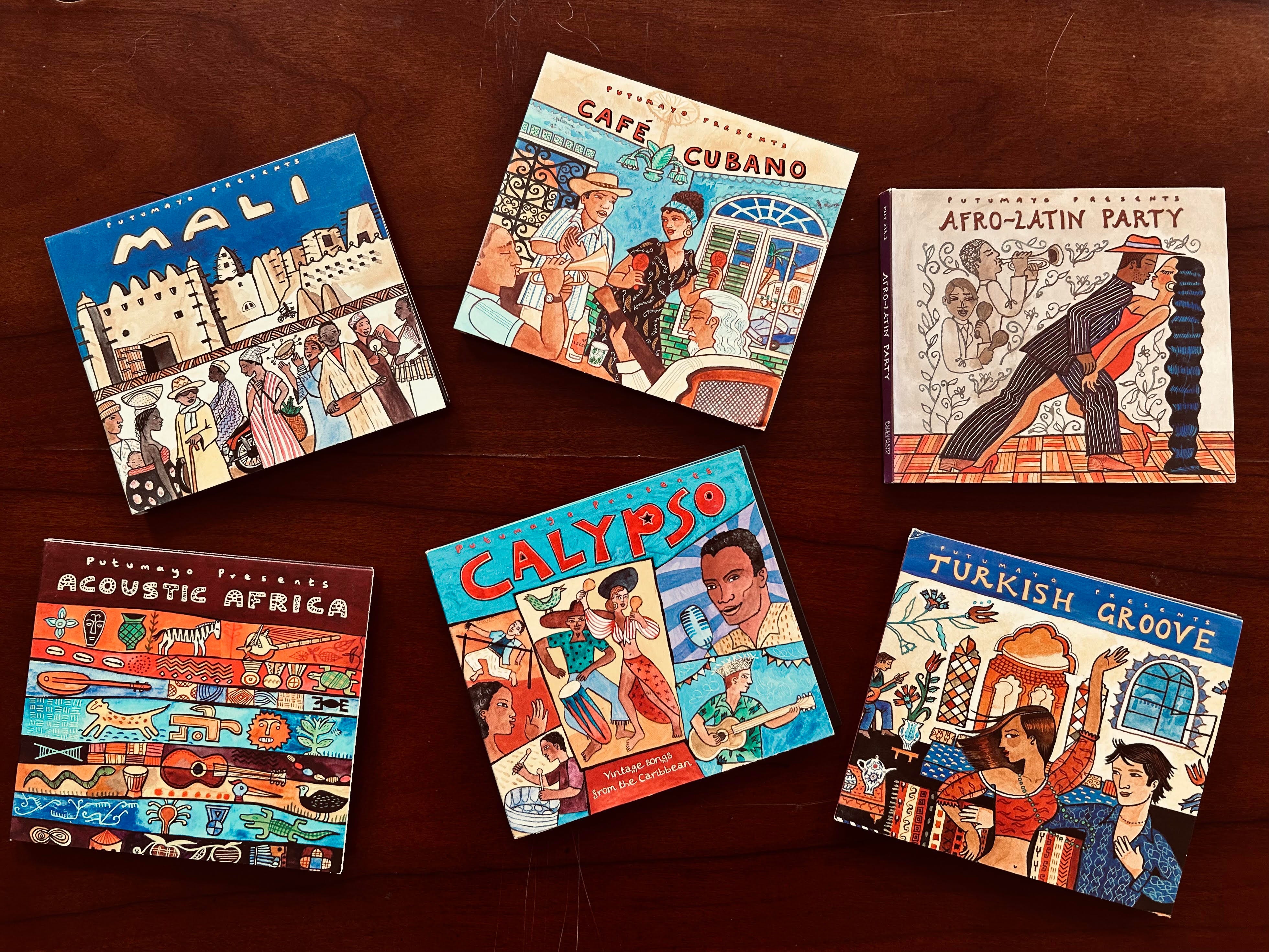
While CDs have seen their day, Putumayo is still doing its thing, putting together ‘compilations’ (playlists) on various streaming outlets. Check it out here…
There are many ways to learn about other cultures. But nothing brings us closer than music. Music is universal. Music has been a part of virtually every culture, all over the world, since the beginning of time. And music is social. We all understand a beat, rhythm, and the desire to move when you hear conga drums. And research shows that we also have a physical reaction when we listen together. Our bodies ‘entrain’ to music, and each other – our heart rates sync, our breathing rhythms match up, and dopamine is released in our brains, which is ‘guaranteed to make you feel good’. Music brings people together.

In the hospital, one of the benefits of music therapy is that it can work around spoken language barriers. In fact, music therapy becomes more essential when hospital staff cannot communicate with patients who speak a foreign language. Being in the hospital is isolating, and not being able to communicate, or connect with staff, exacerbates feelings of being alone. Cue the music therapy…
“He speaks no English so we can’t really talk with him. And he’s had no visitors,” the nurse told me when she asked me to visit with him. He’d already been isolated in the hospital for some time receiving cancer treatment. I walked into his dark room, and it was so quiet I could hear the IV drip. He looked at me and I showed him the guitar and gestured to a chair as if to ask, “May I sit?” He tentatively shook his head “yes”. He was in bed with the covers pulled up. He looked weak. He looked lost. I just started playing something soothing, offering some soundscape for comfort. He was looking straight up but… seemed to be listening.
After a few moments I noticed his left foot slowly moving. I kept the rhythm solid. And then, some movement in his head. I followed him with the music, adding a little more straight structure to my improvisation. His eyes opened fully as his body seemed to ‘activate’. He transformed and the music purposefully followed. More rhythm. More intensity. More movement. Soon, it felt as though we were… grooving?
He looked at me and his smile lit up the gloomy room. It became a music and movement improvised jam-session. And the movement in his body seemed to give him some ‘life’.
Without thinking about it, I eventually worked my way to ‘One Love’ and started singing. He pointed at me, laughed, and said “Ahhh…” Of course he knew Bob Marley! He took it in. He could not stop smiling. No words were spoken for the half hour I was there. There was no need. We had music.
As I was waving goodbye and about to walk out – three words… “Come back again?”
Sometimes we don’t need words. Sometimes we need beauty and rhythm and soul and aesthetics. Sometimes we just need… music. Music gives you what you need, when you need it. No matter where you are from. After all… music is “guaranteed to make you feel good.”
“One love. One heart. Let’s get together and feel alright…”
The healing power of music…
(The stories presented in this newsletter are based on accounts or experiences and are not actual accounts or experiences.)
Raymond Leone, MMT, MT-BC is a board-certified music therapist based in Northern Virginia and writes extensively about music therapy and music and wellness.
Did you know that if you hit the heart at the top or the bottom of this email you will make my day and it will make it easier for others to find this publication. Thanks!
Great stuff Ray! I have been a fan of Putumayo for decades and completely agree their compilations can take our mood and our mind to another locale and brighten our day. Thanks for the reminder! Blessings, Bob Pomeroy
One Love is the perfect universal song for the body & soul. I sing 3 Little Birds to my grands when they need soothing.